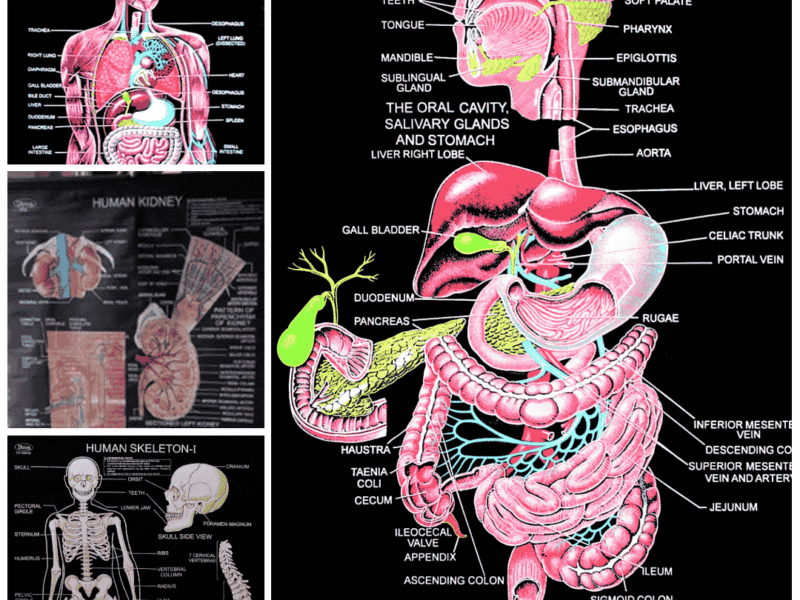
Description
Specifications Table
Product Material – Laminated paper with glossy finish
Pack Size – Single chart
Grade – Laboratory/educational grade
Application – Zoology studies, chordate development reference
Dimensions – 50 x 70 cm (standard lab chart size)
Product Overview
The Herdmania Metamorphosis – Chordata Chart is a meticulously designed educational tool that visually represents the complete developmental stages of Herdmania, a key model organism in chordate studies. This high-resolution chart is printed on premium laminated paper, ensuring durability against frequent handling and exposure to lab conditions. The glossy finish enhances clarity, making intricate anatomical details easily distinguishable even under bright laboratory lighting. Each stage of metamorphosis is accurately labeled with scientific terminology, providing a comprehensive reference for comparative anatomy studies. The chart’s large 50×70 cm dimensions make it suitable for both individual study and classroom demonstrations. Unlike digital alternatives, this physical chart eliminates eye strain during prolonged use while offering the tactile learning experience preferred by many educators. The water-resistant lamination prevents damage from accidental spills, a common occurrence in busy lab environments. This chart serves as an indispensable visual aid for understanding the fundamental principles of chordate development, particularly the transition from larval to adult forms in ascidians.
FAQs
1. What specific developmental stages are illustrated in this Herdmania chart?
The chart comprehensively covers all major metamorphic stages from the larval form through to the adult ascidian, including the tadpole larva, attachment phase, and subsequent morphological transformations.
2. Can this chart be used as a reference for other ascidian species?
While specifically depicting Herdmania, the fundamental developmental patterns illustrated are representative of most solitary ascidians, making it broadly applicable for comparative studies.
3. What is the expected lifespan of this laminated chart under regular lab use?
With proper handling, the chart is designed to maintain its integrity for 5-7 years in typical laboratory conditions, with the lamination protecting against both physical wear and environmental factors.
4. How does this physical chart compare to digital alternatives for study purposes?
Physical charts like this offer constant visual reference without screen fatigue, allow for simultaneous group viewing, and provide the spatial context that many learners find beneficial for understanding complex developmental sequences.
5. Are there any special storage recommendations to maintain the chart’s condition?
Store flat in a cool, dry environment away from direct sunlight. For extended storage periods, placing between acid-free boards will prevent any potential curling of the laminated edges.