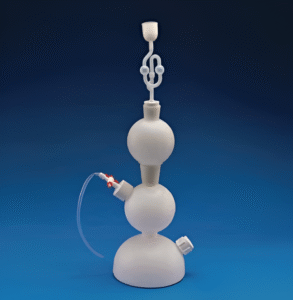
Description
Specifications Table
| Product Name | Kipps Apparatus |
|---|---|
| Quantity/Pack Size | 250ml, 500ml, 1000ml |
| Form | Glass apparatus |
| Grade | Laboratory grade |
| Application | Gas generation, chemical experiments, educational labs |
Product Description
The Kipps Apparatus is a classic piece of laboratory equipment designed for the safe and efficient generation of gases like hydrogen, carbon dioxide, and hydrogen sulfide. Widely used in educational institutions, research labs, and industrial settings, this apparatus ensures controlled gas production for experiments and demonstrations.
Constructed from high-quality borosilicate glass, the Kipps Apparatus is durable and resistant to chemical corrosion, making it ideal for long-term use. The three-chamber design allows for easy loading of reactants and continuous gas flow, while the stopcock enables precise control over gas release.
Whether you’re a student conducting chemistry experiments or a researcher needing reliable gas generation, the Kipps Apparatus from eqipped is a trusted choice. Available in three convenient sizes—250ml, 500ml, and 1000ml—it caters to different experimental needs.
Buy Kipps Apparatus online today for seamless lab experiments and research.
FAQs
What is the Kipps Apparatus used for?
The Kipps Apparatus is used to generate gases like hydrogen, carbon dioxide, and hydrogen sulfide in laboratories for experiments and research.
How do I choose the right size of Kipps Apparatus?
Select the size based on your gas volume requirements. The 250ml version is ideal for small-scale experiments, while the 1000ml model suits larger projects.
Can I buy Kipps Apparatus online in India?
Yes, you can purchase the Kipps Apparatus online from eqipped with fast and reliable delivery across India.
Is the Kipps Apparatus safe for student use?
Yes, but it should be used under supervision, especially when handling reactive chemicals. Always follow lab safety protocols.
What chemicals can be used with the Kipps Apparatus?
Common reactants include zinc with hydrochloric acid (for hydrogen) and calcium carbonate with hydrochloric acid (for carbon dioxide).