Description
Specifications Table
Product Material – High-grade metal and insulated components
Grade – Laboratory/Industrial
Application – Impedance, inductance, capacitance measurement
Product Overview
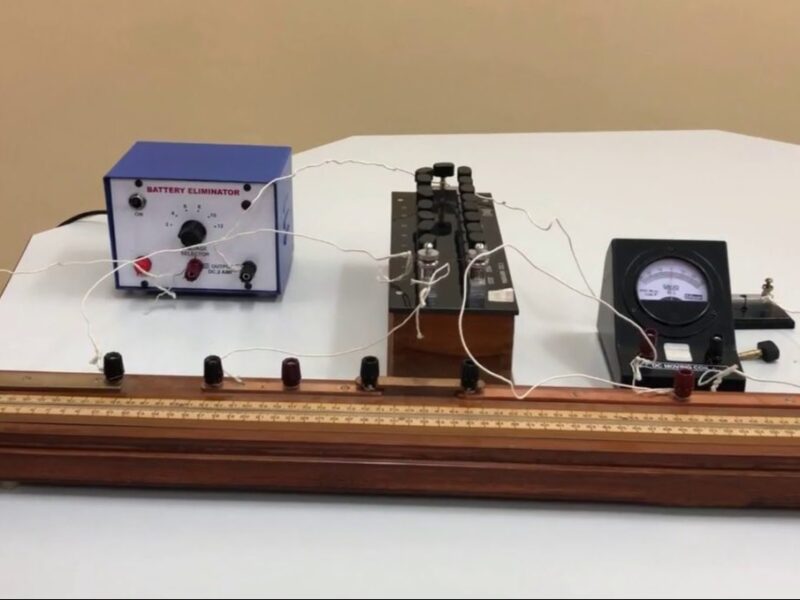
The L.C.R. Q Meter Bridge Type is a precision instrument designed for accurate measurement of inductance (L), capacitance (C), and resistance (R) in electronic components. Engineered for laboratory and industrial applications, this meter ensures high Q-factor accuracy, making it indispensable for testing passive components like coils, capacitors, and resistors. The robust construction with high-grade metal and insulated components guarantees durability and long-term reliability, even under frequent use. Its bridge-type design minimizes measurement errors, providing consistent and repeatable results. The device is calibrated for high sensitivity, allowing detection of even minor variations in component values. Whether used for quality control, research, or educational demonstrations, this L.C.R. Q Meter delivers professional-grade performance with minimal maintenance requirements. The intuitive interface and clear readouts simplify operation, reducing the learning curve for new users while maintaining the precision demanded by experts.
FAQs
1. What is the primary function of an L.C.R. Q Meter Bridge Type?
It measures inductance (L), capacitance (C), and resistance (R) of electronic components with high precision, including Q-factor analysis for coils and capacitors.
2. Can this meter be used for testing surface-mount (SMD) components?
While primarily designed for through-hole components, adapters or fixtures can be used to test SMD parts, though accuracy may vary based on connection stability.
3. What alternatives exist for measuring inductance and capacitance?
Alternatives include digital LCR meters, impedance analyzers, and oscilloscope-based methods, but bridge-type Q meters offer superior accuracy for high-Q components.
4. How should this L.C.R. Q Meter be stored to ensure longevity?
Store in a dry, dust-free environment with stable temperature. Avoid exposure to magnetic fields or direct sunlight to prevent calibration drift.
5. Is this meter suitable for measuring high-frequency components?
The operating frequency range depends on the model, but most L.C.R. Q Meters are optimized for low to mid-frequency applications (typically up to a few MHz).