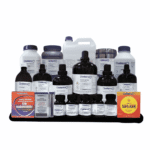
Description
Specifications Table
Product Name – n-Butyl Alcohol ER
Quantity/Pack Size – 2.5 LT, 500 ML
Form – Liquid
Grade – ER (Extra Pure) / Reagent
Application – Organic Synthesis, Solvent, Extraction, Chromatography
product overview
n-Butyl Alcohol, also known as 1-butanol, is a primary alcohol with the chemical formula C4H10O. This high-grade ER (Extra Pure) reagent is meticulously purified to meet stringent laboratory standards, making it indispensable for a wide range of analytical and synthetic procedures. Its colorless, mobile liquid form with a characteristic odor makes it easily identifiable in a laboratory setting. As a versatile organic solvent, n-Butyl Alcohol exhibits excellent dissolving properties for a variety of organic compounds, resins, and oils. Its moderate volatility and miscibility with other organic solvents make it a preferred choice for extraction processes, where it effectively separates components based on their solubility differences. The consistent purity of our n-Butyl Alcohol ER ensures reliable and reproducible results in critical applications, preventing contamination and interference in sensitive experiments. It is commonly employed in techniques such as chromatography, where its solvent properties aid in the separation and purification of complex mixtures. Researchers and educators trust this product for its consistent quality and performance, ensuring precision in every experiment. This solvent is a fundamental component for any well-equipped chemistry laboratory, offering dependability for various chemical reactions and preparatory work.
FAQs
1. What is the purity level of n-Butyl Alcohol ER?
Our n-Butyl Alcohol ER (Extra Pure) grade is manufactured to high purity standards, typically exceeding 99% purity, ensuring minimal impurities for sensitive laboratory work.
2. How should n-Butyl Alcohol be safely stored in the laboratory?
n-Butyl Alcohol should be stored in a tightly sealed container in a cool, well-ventilated area, away from sources of ignition, direct sunlight, and incompatible materials. Keep it in a designated flammables storage cabinet.
3. What are the common uses of n-Butyl Alcohol as a solvent?
As a solvent, n-Butyl Alcohol is widely used for dissolving oils, fats, waxes, resins, and cellulose ethers. It’s also employed in the manufacturing of lacquers, varnishes, and as an extractant in various chemical processes.
4. Is n-Butyl Alcohol compatible with common laboratory plastics?
n-Butyl Alcohol can react with or dissolve some plastics. It is generally recommended to store and handle it in glass or high-density polyethylene (HDPE) containers, but always check compatibility for specific plastic types.
5. Are there any specific handling precautions for n-Butyl Alcohol?
Yes, n-Butyl Alcohol is flammable and its vapors can be irritating. Always use it in a well-ventilated area or under a fume hood. Wear appropriate personal protective equipment including safety goggles, gloves, and a lab coat to prevent skin and eye contact.