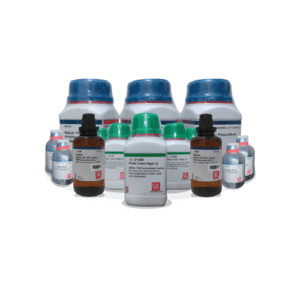
Description
Specifications Table
| Product Name | Palladium Nanopowder (Type I), 30nm, 99.9% | 22116 | SRL Chem |
|---|---|
| Pack Size | 100 Mg – 500 Mg |
| Form | Nanopowder |
| Grade | 99.9% Purity |
| Application | Catalysis, Research, Nanotechnology |
Product Description
Palladium nanopowder is a cutting-edge material designed for high-performance applications in research, catalysis, and nanotechnology. With a particle size of 30nm and 99.9% purity, this nanopowder offers exceptional reactivity and surface area, making it ideal for advanced scientific experiments and industrial processes.
Whether you’re working on catalytic converters, hydrogen storage, or sensor development, this palladium nanopowder delivers consistent results. Its ultra-fine structure ensures uniform dispersion, enhancing efficiency in chemical reactions and material synthesis.
For researchers and educators, this product provides a reliable foundation for experiments requiring high-purity metals. The 30nm particle size is optimized for maximum surface activity, ensuring better performance in electrochemical applications and nanoscale engineering.
Looking for high-quality palladium nanopowder? Buy online at eqipped for guaranteed purity and fast shipping across India.
FAQs
What is the particle size of this palladium nanopowder?
The particle size is 30nm, ensuring high surface area and reactivity for advanced applications.
Is this palladium nanopowder suitable for catalytic applications?
Yes, its 99.9% purity and fine particle size make it ideal for catalysis in chemical and industrial processes.
How should I store palladium nanopowder?
Store in an airtight container in a cool, dry place to prevent oxidation and moisture absorption.
Can I buy palladium nanopowder in bulk?
Yes, eqipped offers bulk quantities for research institutions and industries. Contact us for custom orders.
What are the key advantages of using 30nm palladium nanopowder?
Its ultra-fine particles provide higher surface area, better dispersion, and enhanced catalytic efficiency compared to larger particle sizes.