Description
Specifications Table
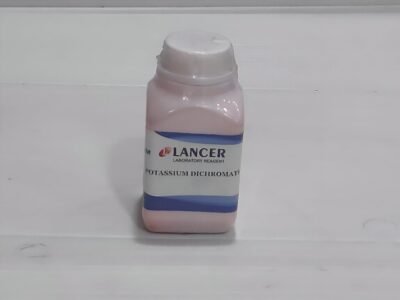
| Product Name | Potassium Dichromate | 1667 | Lancer |
|---|---|
| Quantity/Pack Size | 500 gm |
| Form | Orange-red crystals |
| Grade | Laboratory Grade |
| Application | Oxidizing agent, analytical reagent, chromatography |
Product Description
Potassium Dichromate is a versatile inorganic compound widely used in laboratories across India for its strong oxidizing properties. This high-purity laboratory-grade chemical from Lancer (Catalog No. 1667) comes in a convenient 500g pack, making it ideal for educational institutions, research facilities, and quality control laboratories.
The bright orange-red crystals dissolve easily in water, providing a reliable solution for various analytical applications. Whether you’re conducting titrations, preparing chromic acid solutions, or using it as an oxidizing agent in organic synthesis, this product delivers consistent results.
At eqipped, we understand the importance of quality reagents in scientific work. That’s why we source our Potassium Dichromate from trusted manufacturers to ensure you receive a product that meets strict laboratory standards. The 500g packaging offers excellent value while maintaining freshness and purity.
Common applications include:
- Volumetric analysis and titrations
- Chromium plating solutions
- Oxidation reactions in organic chemistry
- Cleaning glassware in laboratories
- Preparation of chrome pigments
Looking for pure Potassium Dichromate for your lab? Order your 500g pack today and experience the eqipped difference in quality and service.
For educational institutions, this product serves as an excellent teaching aid for demonstrating oxidation-reduction reactions. Researchers appreciate its reliability in quantitative analysis. The laboratory grade ensures minimal impurities that could affect experimental outcomes.
When handling Potassium Dichromate, always follow proper laboratory safety protocols. Store in a cool, dry place away from incompatible substances. The 500g quantity provides sufficient material for multiple experiments while minimizing storage concerns.
Safety Information
Potassium Dichromate is a strong oxidizer and may cause severe skin irritation and eye damage. It is harmful if swallowed or inhaled. Always wear appropriate personal protective equipment (PPE) including gloves, goggles, and lab coat when handling. Use in a well-ventilated area or under a fume hood. Keep away from heat, sparks, and open flames.
FAQs
What is Potassium Dichromate used for in laboratories?
Potassium Dichromate is widely used as a laboratory reagent in analytical chemistry, inorganic chemistry, oxidation reactions, titrimetric analysis, reagent preparation, and research involving chromium compounds. It is commonly employed as a strong oxidizing agent in laboratory applications.
Is this Potassium Dichromate suitable for research and analytical laboratories?
Yes, this Lancer Potassium Dichromate is suitable for research laboratories, educational institutions, analytical chemistry laboratories, universities, pharmaceutical laboratories, and industrial quality control facilities requiring a laboratory-grade inorganic reagent.
How should Potassium Dichromate be stored?
Store the product in its original tightly closed container in a cool, dry, and well-ventilated place away from moisture, direct sunlight, heat, combustible materials, reducing agents, and incompatible chemicals. Follow the manufacturer’s recommended storage conditions to maintain product quality and stability.
What safety precautions should I follow while handling Potassium Dichromate?
Wear appropriate laboratory PPE, including chemical-resistant gloves, safety goggles, and a lab coat. Handle the material in a well-ventilated area, avoid inhalation of dust and contact with the skin or eyes, and refer to the product Safety Data Sheet (SDS) before use.
Can I buy Lancer Potassium Dichromate online from eqipped?
Yes, eqipped supplies genuine Lancer laboratory reagents with secure packaging, reliable delivery across India, and bulk purchasing options for research laboratories, universities, educational institutions, pharmaceutical companies, and industrial quality control laboratories.