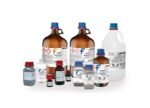
Description
Specifications Table
Product Name – Potassium trimethylsilanolate, 2M solution in THF, AcroSeal®
Quantity/Pack Size – 100ML, 800ML
Form – Liquid (THF solution)
Grade – AcroSeal®
Application – Silylation, deprotonation, organometallic synthesis
Product Overview
Potassium trimethylsilanolate, 2M solution in THF, is a highly reactive organosilicon reagent supplied in AcroSeal® packaging to ensure maximum stability and purity. This moisture-sensitive compound is widely recognized for its role in silylation reactions, where it efficiently converts alcohols, phenols, and carboxylic acids into their corresponding trimethylsilyl derivatives. The THF solvent enhances solubility and reactivity, making it ideal for organometallic synthesis and deprotonation processes. The AcroSeal® technology provides an airtight seal, preventing contamination and degradation during storage and handling. This solution is particularly valued in applications requiring precise stoichiometry and high yields, as its standardized 2M concentration simplifies reagent measurement. The product is compatible with standard laboratory glassware and can be used under inert conditions for optimal performance. Its stability in THF ensures consistent results across multiple experimental setups.
FAQs
1. What is the shelf life of potassium trimethylsilanolate in THF?
The shelf life is typically 12 months when stored unopened in its original AcroSeal® packaging at recommended temperatures.
2. Can this solution be used in non-inert conditions?
No, it is highly moisture-sensitive and should only be handled under inert gas (argon/nitrogen) to prevent decomposition.
3. What are the storage requirements for this reagent?
Store at 2-8°C in a tightly sealed container, away from moisture and ignition sources.
4. Is this compatible with standard Schlenk line techniques?
Yes, it can be transferred using Schlenk line or syringe techniques under inert conditions.
5. What alternatives exist for silylation reactions?
Alternatives include sodium hexamethyldisilazide (NaHMDS) or lithium diisopropylamide (LDA), though reactivity profiles differ.