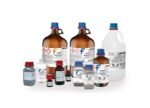
Description
Specifications Table
Product Name – Propanephosphonic acid cyclic anhydride, 50 wt.% solution in dimethylformamide, AcroSeal®
Quantity/Pack Size – 100ML
Form – Liquid (solution in DMF)
Grade – Synthesis Grade
Application – Phosphonation, peptide coupling, organic synthesis
Product Overview
Propanephosphonic acid cyclic anhydride (50 wt.% in dimethylformamide) is a highly reactive phosphonating agent designed for precision organic synthesis. The AcroSeal® packaging ensures moisture-sensitive stability, maintaining the reagent’s potency for critical applications like peptide coupling and phosphonate ester formation. This solution-grade product eliminates the need for additional solvent handling, offering consistent performance in reactions requiring controlled phosphonation. The dimethylformamide (DMF) solvent enhances solubility while preserving the anhydride’s reactivity, making it compatible with a wide range of substrates. Its synthesis-grade purity minimizes side reactions, ensuring reliable yields in demanding laboratory protocols. Ideal for researchers requiring a stable, ready-to-use phosphonating reagent without compromising on reactivity or handling convenience.
FAQs
1. What is the shelf life of this propanephosphonic acid cyclic anhydride solution?
When stored unopened in its original AcroSeal® packaging at room temperature, the solution retains stability for up to 12 months. Exposure to moisture or air accelerates degradation, so reseal tightly after use.
2. Is this solution compatible with aqueous reaction systems?
The DMF solvent and anhydride structure are hydrophobic, making it unsuitable for direct use in aqueous environments. Pre-dissolution in organic co-solvents like THF or acetonitrile is recommended for mixed-phase reactions.
3. Can this reagent replace T3P (propanephosphonic acid anhydride) in standard protocols?
Yes, this 50% solution functions similarly to T3P but offers enhanced solubility due to the DMF solvent. Adjust molar equivalents based on the active anhydride concentration (50 wt.%) for equivalent reactivity.
4. What precautions are needed for handling this solution?
Use in a fume hood with nitrile gloves and safety goggles. The DMF solvent is a skin irritant, and the anhydride is moisture-sensitive. Avoid inhalation of vapors and ensure proper ventilation during use.
5. How does the DMF solvent affect reaction selectivity compared to neat anhydride?
The DMF solvent moderates reactivity slightly, reducing the risk of over-phosphonation in sensitive substrates. For highly reactive substrates, the solution may require longer reaction times than neat anhydride.