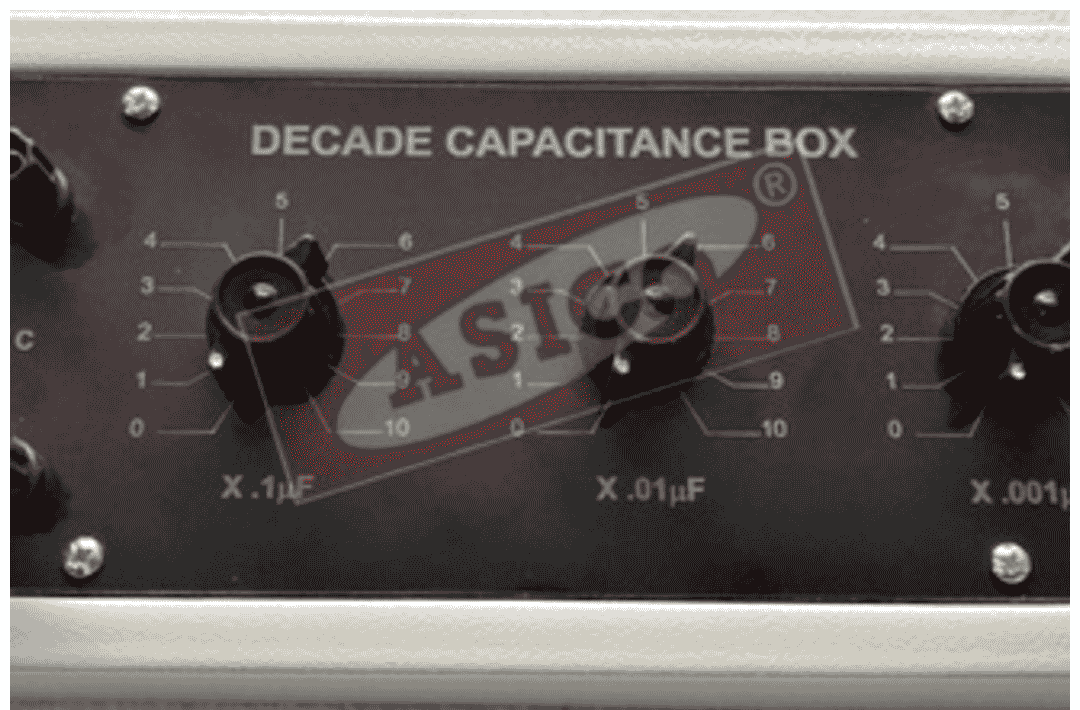
Description
Specifications Table
Product Material – High-grade metal/alloy components with insulated terminals
Grade – Laboratory/Industrial Standard
Application – Capacitance measurement, dissipation factor testing, dielectric loss analysis
Product Overview
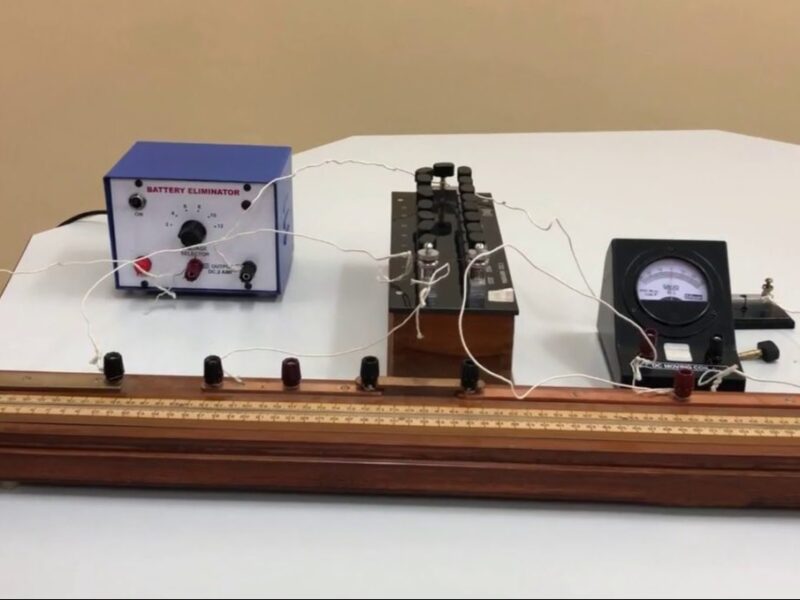
The Schering Bridge (With Headphone & Bridge Oscillator) is a precision instrument designed for accurate measurement of capacitance and dissipation factors in laboratory settings. Engineered with high-grade metal components and insulated terminals, this bridge ensures minimal signal loss and maximum reliability during experiments. The integrated headphone jack allows for clear audio detection of balance points, while the built-in oscillator provides a stable frequency source (typically 1kHz) for consistent measurements. The bridge’s robust construction makes it resistant to electrical interference, ensuring precise readings even in demanding environments. Unlike basic capacitance meters, this Schering Bridge offers adjustable arms for fine-tuning measurements across a wide range of capacitor values, from picofarads to microfarads. The inclusion of a null detector (via headphone) eliminates the need for external equipment, streamlining the testing process. Whether used for quality control, material characterization, or educational demonstrations, this instrument delivers professional-grade accuracy with minimal calibration requirements. Its compact yet sturdy design ensures longevity, making it a cost-effective investment for long-term lab use.
FAQs
1. How does the Schering Bridge differ from a standard Wheatstone bridge?
The Schering Bridge is specifically optimized for capacitance and dissipation factor measurements, whereas a Wheatstone bridge is primarily used for resistance measurements. The Schering configuration includes a built-in oscillator and headphone for audio null detection, which is critical for precise capacitance testing.
2. Can this bridge measure both high and low capacitance values?
Yes, the adjustable arms of the Schering Bridge allow it to measure a broad range of capacitance values, from picofarads (pF) to microfarads (µF), by selecting appropriate ratio settings and standard capacitors.
3. What is the typical frequency range of the built-in oscillator?
The integrated oscillator generally operates at a fixed frequency of 1kHz, which is the standard for most dielectric loss and capacitance measurements in laboratory applications.
4. Is external calibration required before use?
Minimal calibration is needed if the bridge is used with known standard capacitors. For high-precision work, periodic verification with certified reference capacitors is recommended to maintain accuracy.
5. What safety precautions should be taken while operating this bridge?
Always ensure the circuit is properly grounded to avoid static buildup. Avoid touching live terminals during operation, and use insulated probes if handling high-voltage components. The headphone should be used at safe volume levels to prevent hearing strain during prolonged null detection.