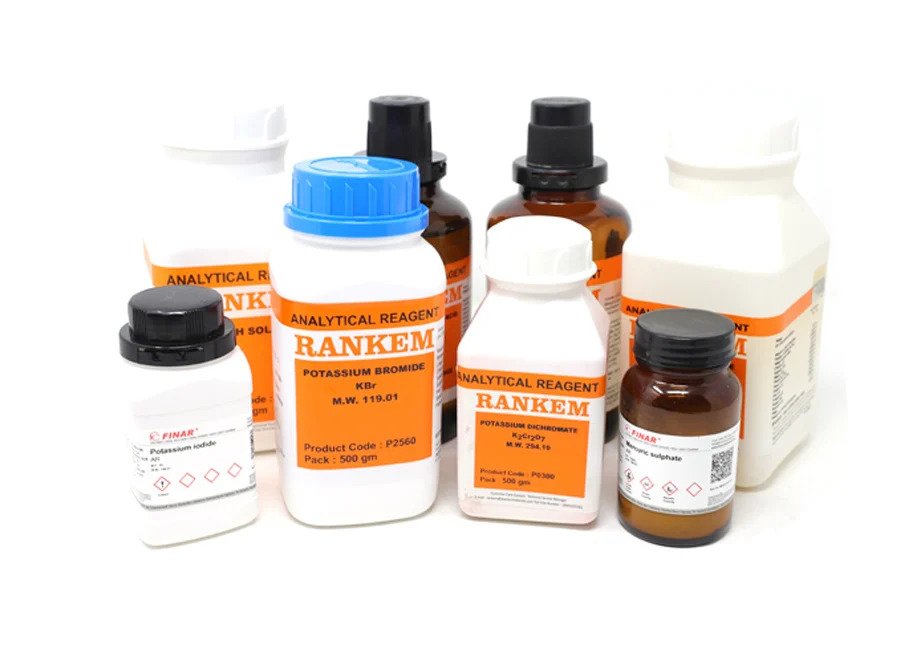
Description
Specifications Table
Product Name – Silver diethyldithiocarbamate
Quantity/Pack Size – 5 g
Form – Solid (powder/crystals)
Grade – Analytical Reagent (AR)
Application – Trace metal analysis, qualitative tests, complexometric titrations
Product Overview
Silver diethyldithiocarbamate is a high-purity analytical reagent designed for precision in qualitative and quantitative chemical analyses. This compound, classified as an analytical reagent (AR) grade, ensures minimal impurities, making it suitable for sensitive applications where accuracy is critical. Its chemical structure enables selective complexation with metal ions, particularly arsenic and mercury, facilitating reliable detection even at trace levels. The reagent’s stability under standard laboratory conditions allows for consistent performance across repeated experiments. Its solid form, typically available as a fine powder or crystalline structure, ensures easy handling and precise measurement during preparation. The compound’s compatibility with common organic solvents and aqueous systems further enhances its versatility in various analytical protocols. As a specialized reagent, it is particularly valued in environmental testing, toxicology, and industrial quality control processes where metal contamination must be rigorously monitored. The 5 g packaging provides an optimal balance between sufficient quantity for multiple tests and cost-effective storage for laboratories with moderate usage requirements.
FAQs
1. What is the shelf life of silver diethyldithiocarbamate when stored properly?
The reagent typically maintains its stability for 2-3 years when stored in a cool, dry place away from direct sunlight and moisture.
2. Can this reagent be used for detecting metals other than arsenic?
While primarily used for arsenic detection, it also shows reactivity with mercury and some other heavy metals under specific conditions.
3. What is the recommended storage temperature for this compound?
Store between 15-25°C in a tightly sealed container to prevent degradation from atmospheric exposure.
4. Is this reagent compatible with standard volumetric glassware?
Yes, it can be accurately measured using standard laboratory glassware, though plastic spatulas are recommended to avoid potential metal contamination.
5. What safety precautions should be taken when handling this chemical?
Use in a well-ventilated area with appropriate personal protective equipment including gloves and goggles, as it may cause skin and eye irritation.