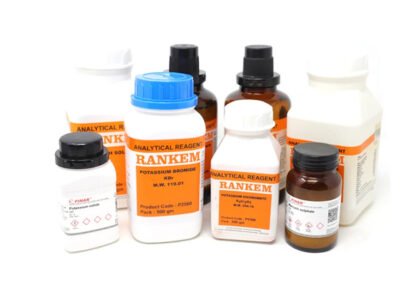
Description
Specifications Table
| Product Name | Sodium acetate, 3H2O AnalaR NORMAPUR® ACS reagent, Reag. Ph. Eur. |
|---|---|
| Pack Size | 5 kg |
| Form | Crystalline powder |
| Grade | AnalaR NORMAPUR®, ACS reagent, Reag. Ph. Eur. |
| Application | Density standard (1000.5 g/ml), calibration, analytical chemistry |
Product Description
Sodium acetate trihydrate is a versatile laboratory reagent widely used as a density standard for calibration. With a certified density of 1000.5 g/ml, this AnalaR NORMAPUR® grade product meets ACS and Ph. Eur. specifications, ensuring accuracy in analytical procedures. Whether you’re calibrating instruments or preparing buffer solutions, this high-purity sodium acetate trihydrate delivers consistent results.
For researchers and educators, this 5 kg pack offers excellent value without compromising quality. The crystalline form dissolves easily in water, making it convenient for various applications. From academic labs to industrial settings, this reagent is trusted for its reliability.
Need a reliable density standard for your lab? Buy Sodium Acetate Trihydrate online from eqipped today.
Sodium acetate trihydrate is particularly useful in: – Density calibration of laboratory equipment – Buffer solution preparation – Analytical chemistry procedures – Educational demonstrations
When working with this chemical, always follow proper lab safety protocols. Store in a cool, dry place away from incompatible substances.
FAQs
What is the density of this sodium acetate trihydrate?
This product has a certified density of 1000.5 g/ml, making it ideal for calibration purposes.
Is this suitable for ACS-grade applications?
Yes, this sodium acetate trihydrate meets ACS reagent specifications and is also compliant with Ph. Eur. standards.
How should I store this chemical?
Store in a tightly sealed container in a cool, dry place. Keep away from moisture and incompatible substances.
Can this be used for buffer preparation?
Absolutely. Sodium acetate trihydrate is commonly used to prepare buffer solutions in biochemical and analytical applications.
What safety precautions should I take?
Wear appropriate PPE (gloves, goggles) when handling. Avoid inhalation and contact with skin or eyes. Refer to the SDS for complete safety information.