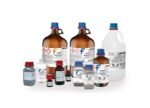
Description
Specifications Table
Product Name – Sodium chloride, 99.5%, for analysis
Quantity/Pack Size – 1KG, 5KG, 25KG
Form – Crystalline powder
Grade – For analysis
Application – Chemical analysis, titrations, reagent preparation
Product Overview
Sodium chloride, 99.5% pure and analysis-grade, is a fundamental laboratory reagent designed for high-precision applications. This crystalline powder undergoes rigorous purification to ensure minimal impurities, making it ideal for sensitive analytical procedures. Its consistent composition guarantees reliable results in titrations, buffer preparations, and other critical chemical tests. The high solubility in water allows for easy dissolution, while its stable nature ensures long-term storage without degradation. This grade is specifically formulated to meet the stringent requirements of analytical chemistry, where accuracy and reproducibility are paramount. The product is packaged in airtight containers to prevent moisture absorption and contamination, preserving its purity until use. Whether used as a primary standard or a supporting reagent, this sodium chloride delivers exceptional performance in laboratory settings.
FAQs
1. What is the purity level of this sodium chloride?
This sodium chloride is 99.5% pure, making it suitable for analytical applications where high accuracy is required.
2. Can this sodium chloride be used for preparing standard solutions?
Yes, its high purity and consistent composition make it ideal for preparing standard solutions in titrations and other quantitative analyses.
3. How should this sodium chloride be stored to maintain its purity?
Store it in a cool, dry place in its original airtight container to prevent moisture absorption and contamination.
4. Is this sodium chloride compatible with other common lab reagents?
Yes, it is compatible with most common laboratory reagents, but always verify specific reactions before use.
5. What alternatives exist if this grade of sodium chloride is unavailable?
For general lab use, lower purity grades (99% or 98%) may suffice, but for analytical work, only high-purity alternatives should be considered.