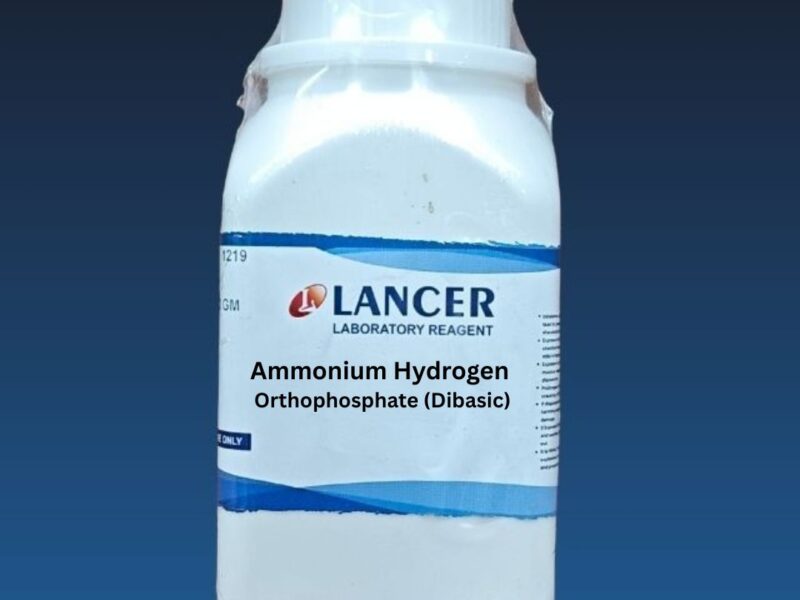
Description
Specifications Table
Product Name – Sodium phosphate, dibasic, 99+%, ACS reagent, suitable for buffer solutions
Quantity/Pack Size – 500GR, 2.5KG, 10KG
Form – Powder
Grade – ACS Reagent
Application – Buffer preparation, molecular biology, biochemistry
Product Overview
Sodium phosphate dibasic, with a minimum purity of 99%, is an ACS reagent-grade chemical designed for high-precision laboratory applications. This anhydrous, crystalline powder is highly soluble in water, making it ideal for preparing phosphate buffers that maintain stable pH levels in biological and chemical assays. Its ACS certification ensures low impurity levels, including minimal heavy metals and insoluble matter, which is critical for sensitive analytical techniques such as chromatography, electrophoresis, and enzymatic reactions. The compound’s buffering capacity between pH 5.8 and 8.0 allows for versatile use in cell culture media, DNA/RNA extraction protocols, and protein purification workflows. Unlike technical-grade alternatives, this reagent-grade product undergoes rigorous quality control to meet American Chemical Society standards, guaranteeing consistency across experimental batches. Its hygroscopic nature requires storage in a cool, dry environment to prevent moisture absorption, which could alter its molecular weight and buffering efficiency. Compatible with most aqueous solutions, it can be combined with sodium phosphate monobasic to create phosphate-buffered saline (PBS) or other customized buffer systems. The absence of additives or stabilizers ensures compatibility with downstream applications, including mass spectrometry and high-performance liquid chromatography (HPLC). For researchers requiring reproducible results, this sodium phosphate dibasic offers a reliable foundation for experimental success.
FAQs
1. What is the exact pH range this sodium phosphate dibasic can buffer effectively?
This compound is most effective for buffering between pH 5.8 and 8.0 when used in combination with sodium phosphate monobasic to create a phosphate buffer system. The exact pH depends on the ratio of dibasic to monobasic phosphate in the solution.
2. Can this product be used directly for cell culture applications without further purification?
Yes, the ACS reagent grade ensures low endotoxin and heavy metal contamination, making it suitable for most cell culture applications without additional purification. However, for highly sensitive cell lines, sterile filtration is recommended after buffer preparation.
3. How does the 99% purity compare to technical-grade sodium phosphate dibasic?
The 99% ACS reagent grade contains significantly fewer impurities, including heavy metals (typically <0.001%), insoluble matter, and residual solvents, compared to technical-grade versions, which may have purity levels as low as 95-97%. This makes it more reliable for analytical and biological applications.
4. What is the shelf life of this product when stored under ideal conditions?
When stored in a tightly sealed container at room temperature (15-30°C) and protected from moisture, the product remains stable for at least 3 years. Exposure to humidity can lead to caking or degradation over time.
5. Is this sodium phosphate dibasic compatible with EDTA or other chelating agents in buffer solutions?
Yes, it can be combined with EDTA or EGTA in buffer formulations, but the final pH should be verified, as chelating agents may slightly alter the buffering capacity. Adjustments with HCl or NaOH may be necessary to achieve the desired pH.