Description
Specifications Table
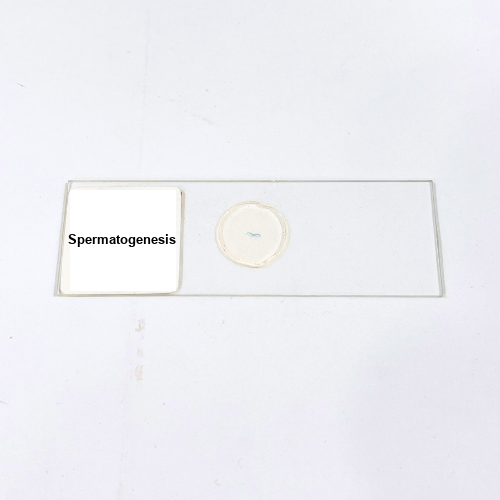
Product Name – Spermatogenesis
Quantity/Pack Size – 1 Slide
Form – Mounted Slide
Grade – Laboratory Grade
Application – Microscopic examination of sperm cell development stages for detailed cellular observation
Product Overview
The Spermatogenesis slide is a meticulously prepared, laboratory-grade specimen designed to provide a clear and detailed view of sperm cell development. The slide features precisely mounted testicular tissue, highlighting the sequential stages of spermatogenesis, including spermatogonia, primary and secondary spermatocytes, spermatids, and mature spermatozoa. High-quality staining techniques emphasize the nuclear and cytoplasmic structures, allowing clear visualization of chromatin condensation, nucleolus formation, and cytoplasmic changes during development. The slide maintains structural integrity, preserving natural morphology while ensuring optimal contrast for microscopic analysis. Its orientation highlights the progression of germ cells from the basal layer of seminiferous tubules to the lumen, facilitating observation of cellular differentiation patterns and organization. Quality control ensures consistent staining, alignment, and secure mounting to prevent specimen damage or distortion during handling. Compatible with standard optical microscopes, the Spermatogenesis slide offers durable mounting for repeated examination without degradation. This slide is an essential tool for detailed observation of male reproductive cell development, enabling reliable analysis of cytological features. Its high-fidelity preparation and long-lasting durability ensure accurate structural representation, providing a valuable resource for laboratory studies and research requiring precise visualization of spermatogenic processes.
1. What developmental stages are visible on this spermatogenesis slide?
The slide displays spermatogonia, primary and secondary spermatocytes, spermatids, and mature spermatozoa with clear structural details.
2. Is this slide compatible with standard laboratory microscopes?
Yes, it is compatible with all conventional optical microscopes for detailed observation of sperm cell development.
3. Are there alternative slides for studying reproductive cells?
Yes, alternatives include oogenesis slides and other gametogenesis preparations for comparative analysis.
4. How should this slide be stored to maintain quality?
Store in a dry, dust-free environment away from direct sunlight to preserve staining and specimen integrity.
5. What is the source of tissue used in this slide?
The testicular tissue is collected from controlled laboratory sources and processed under strict protocols to maintain accurate cellular representation.