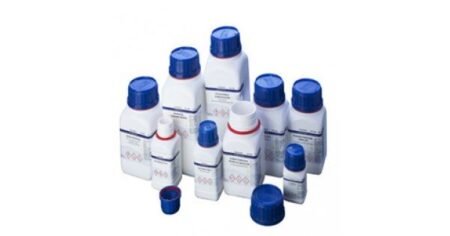
Description
Specifications Table
| Product Name | trans-1,2-Diaminocyclohexane-N,N,N’,N’-tetraacetic Acid Monohydrate 99% AR/ACS |
|---|---|
| Pack Size | 100g | 500g | 1kg |
| Form | White crystalline powder |
| Grade | AR/ACS |
| Application | Chelating agent in biochemical assays, metal ion buffering, and analytical chemistry |
Product Description
trans-1,2-Diaminocyclohexane-N,N,N’,N’-tetraacetic Acid Monohydrate, commonly known as CDTA, is a high-purity chelating agent widely used in laboratories for its strong metal-binding properties. With a purity of 99% AR/ACS grade, this compound is ideal for applications requiring precise metal ion control, such as biochemical research, analytical chemistry, and enzyme studies.
This versatile chelator forms stable complexes with a variety of metal ions, making it a preferred choice for researchers working on metal ion buffering, protein purification, and spectrophotometric analysis. Its trans-configuration ensures optimal performance in complexation reactions, providing reliable results in critical experiments.
Whether you’re setting up a new lab or restocking essential reagents, eqipped offers this high-quality CDTA monohydrate in convenient pack sizes to suit your research needs. Our commitment to quality ensures you receive a product that meets the strictest analytical standards.
Need a reliable chelating agent for your research? Buy trans-1,2-Diaminocyclohexane-N,N,N’,N’-tetraacetic Acid Monohydrate 99% online today and experience seamless delivery.
Key Applications
CDTA is particularly valuable in biochemical and analytical laboratories for:
- Metal ion buffering in enzyme assays
- Preparation of metal-free solutions
- Spectrophotometric analysis of metal ions
- Protein purification and stabilization
- Research in coordination chemistry
Why This Grade Matters
The AR/ACS grade designation indicates this product meets both Analytical Reagent and American Chemical Society standards, ensuring:
- High purity with minimal impurities
- Consistent performance in sensitive applications
- Reliable results in quantitative analysis
- Suitability for publication-quality research
Safety and Handling
While CDTA is generally stable under normal laboratory conditions, proper handling is recommended:
- Store in a cool, dry place away from moisture
- Use appropriate personal protective equipment (gloves, goggles)
- Avoid inhalation of dust and direct skin contact
- Dispose of according to local chemical waste regulations
FAQs
What is the difference between CDTA and EDTA?
CDTA (trans-1,2-Diaminocyclohexane-N,N,N’,N’-tetraacetic Acid) forms stronger complexes with certain metal ions compared to EDTA, particularly with calcium and magnesium. Its rigid cyclohexane ring structure provides different selectivity in chelation reactions.
Can this product be used for cell culture applications?
While primarily used in biochemical assays, the AR/ACS grade purity makes it suitable for cell culture applications where metal ion control is critical. However, we recommend checking specific protocol requirements for your cell line.
What is the solubility of CDTA monohydrate?
CDTA monohydrate is soluble in water and alkaline solutions. For complete dissolution, we recommend adding it slowly to warm water while stirring. The solubility is approximately 1 g/100ml at room temperature.
How should I store this chemical?
Store the product in its original container, tightly sealed, at room temperature (15-30°C). Keep away from direct sunlight and moisture to maintain stability and prevent degradation.
Is this product suitable for HPLC applications?
While not specifically formulated for HPLC, the high purity (99% AR/ACS grade) makes it suitable for many analytical applications. For HPLC use, we recommend checking compatibility with your specific mobile phase and column requirements.