Description
Specifications Table
Product Material – High-grade metal and PCB components
Grade – Educational/Laboratory
Application – BJT characteristic analysis, CE configuration experiments
Product Overview
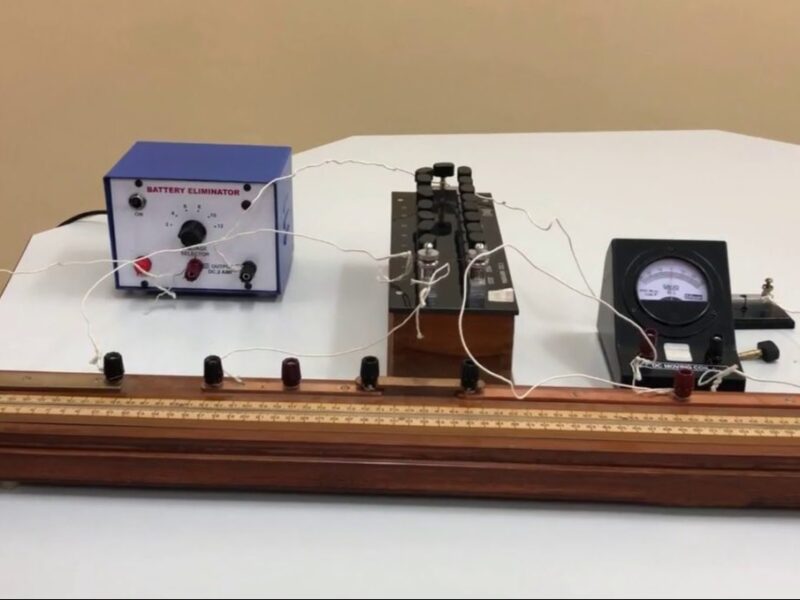
The Transistor / BJT Characteristics Apparatus (CE NPN) is a precision-engineered lab instrument designed for studying the common-emitter (CE) configuration of NPN bipolar junction transistors (BJTs). Built with high-grade metal and robust PCB components, this apparatus ensures accurate measurements and long-term reliability during experiments. The setup allows users to analyze key transistor parameters such as input/output characteristics, current gain, and voltage relationships in CE mode. Its educational-grade design makes it suitable for detailed laboratory work, providing clear insights into transistor behavior under varying conditions. The apparatus is equipped with labeled terminals for easy connections and includes protective features to prevent damage from incorrect wiring. Whether used for basic electronics training or advanced research, this CE NPN transistor kit delivers consistent performance, making it an essential tool for electronics laboratories. The durable construction and precise calibration ensure repeatable results, while the compact design allows for easy integration into existing lab setups.
FAQs
1. What type of transistor configuration does this apparatus support?
This apparatus is specifically designed for studying the common-emitter (CE) configuration of NPN bipolar junction transistors (BJTs).
2. Can this kit be used for testing other transistor types?
No, this apparatus is optimized only for NPN transistors in CE configuration and may not provide accurate results for other transistor types or configurations.
3. What safety features are included in this transistor apparatus?
The kit includes labeled terminals to prevent incorrect connections and has built-in protection against reverse polarity to safeguard the components during experiments.
4. Is this apparatus suitable for industrial applications?
While highly accurate, this apparatus is primarily designed for educational and laboratory use rather than industrial-scale applications.
5. How should this transistor apparatus be stored when not in use?
Store the apparatus in a dry, dust-free environment at room temperature, and keep it away from direct sunlight or moisture to maintain its performance and longevity.