Description
Specifications Table
Product Material – High-quality metal and PCB components
Grade – Educational/Laboratory Grade
Application – Signal transmission studies, impedance measurement, reflection analysis
Product Overview
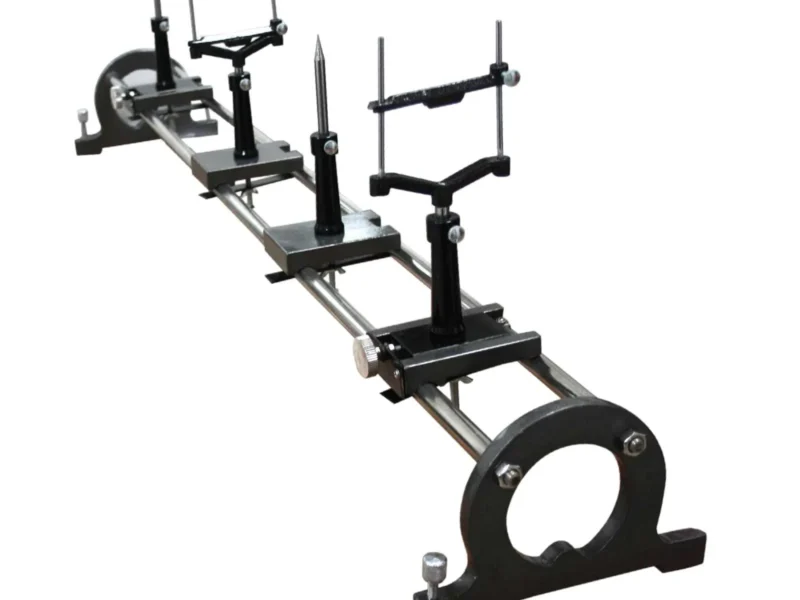
The Transmission Line Trainer is a precision-engineered educational tool designed to demonstrate the fundamental principles of signal transmission, impedance matching, and wave propagation. Built with high-grade metal and durable PCB components, this trainer ensures accurate and repeatable results for laboratory experiments. The system allows users to analyze signal behavior under varying conditions, including open-circuit, short-circuit, and matched-load scenarios, making it an indispensable resource for understanding transmission line theory. Its robust construction and clear labeling facilitate easy setup and operation, while the included measurement points enable detailed data collection. Whether used for studying standing waves, calculating reflection coefficients, or verifying transmission line equations, this trainer provides a hands-on learning experience with professional-grade reliability. The modular design allows for flexible experimentation, accommodating different frequencies and line configurations to suit a wide range of educational applications.
FAQs
1. What type of signals can be analyzed using this Transmission Line Trainer?
This trainer is compatible with low-frequency to RF signals, typically ranging from audio frequencies up to several hundred MHz, depending on the line characteristics.
2. Is this trainer suitable for measuring both characteristic impedance and reflection coefficients?
Yes, the design includes features for calculating characteristic impedance and analyzing reflection coefficients through voltage standing wave ratio (VSWR) measurements.
3. Can this trainer be used with external signal generators?
Absolutely, the system is equipped with standard connectors to interface with external signal generators, oscilloscopes, and other lab instruments.
4. What safety precautions should be followed while operating this trainer?
Ensure proper grounding, avoid exceeding the recommended voltage levels, and handle the connectors carefully to prevent signal distortions or equipment damage.
5. Does this trainer require any additional accessories for full functionality?
While the trainer is functional as a standalone unit, using it with an oscilloscope, function generator, and connecting cables enhances its experimental capabilities.