Description
Specifications Table
Product Material – High-grade metal and insulated wires
Grade – Educational/Lab Grade
Application – Verification of Norton & Thevenin’s Theorem
Product Overview
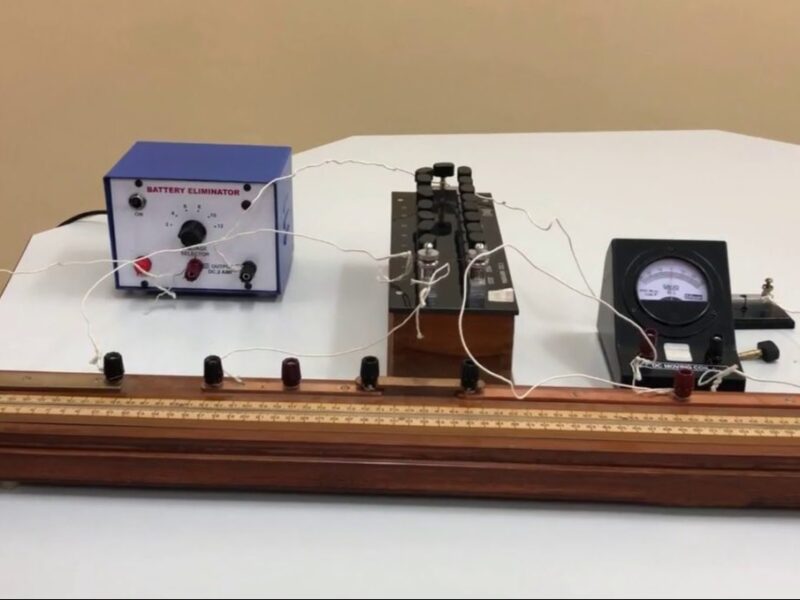
The Verification of Norton & Thevenin’s Theorem (Combined Model) is a meticulously designed lab apparatus engineered to facilitate accurate and reliable experiments in electrical circuit analysis. This combined model allows users to practically demonstrate and verify the fundamental principles of Norton’s and Thevenin’s theorems, which are cornerstones of electrical engineering. The kit is constructed using high-grade materials, including durable metal components and insulated wires, ensuring longevity and consistent performance under repeated use. The model is optimized for clarity, with clearly labeled terminals and connections that simplify the experimental setup, reducing the risk of errors during testing. The design adheres to educational lab standards, making it suitable for both beginners and advanced users who require precise results. Whether used for teaching or research, this apparatus provides a hands-on approach to understanding complex circuit theories, reinforcing theoretical knowledge with practical application. The robust construction and user-friendly layout make it an essential tool for any electrical lab, ensuring that experiments are conducted efficiently and with high accuracy.
FAQs
1. What materials are used in the construction of this Norton & Thevenin’s Theorem kit?
The kit is constructed using high-grade metal for the structural components and insulated wires for safe and reliable electrical connections.
2. Is this model suitable for both Norton’s and Thevenin’s theorem verification?
Yes, this combined model is specifically designed to verify both Norton’s and Thevenin’s theorems in a single setup, making it versatile for lab experiments.
3. Can this apparatus be used for advanced electrical circuit experiments?
While primarily designed for theorem verification, the kit’s durable construction and precise components make it adaptable for a range of basic to intermediate electrical experiments.
4. How should this kit be stored to ensure longevity?
Store the kit in a dry, dust-free environment, preferably in a protective case or box to prevent damage to the components and wiring.
5. Are there any safety precautions to follow while using this model?
Always ensure proper grounding and avoid overloading the circuits. Use insulated tools and follow standard lab safety protocols to prevent electrical hazards.