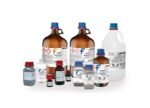
Description
Specifications Table
Product Name – Water, pure, demineralized
Quantity/Pack Size – 5LT, 20LT
Form – Liquid
Grade – Laboratory Grade (Type II)
Application – Reagent preparation, glassware rinsing, media preparation, buffer solutions
Product Overview
This high-purity demineralized water undergoes a rigorous deionization process to remove dissolved minerals, ions, and organic impurities, ensuring ultra-low conductivity (≤0.1 µS/cm at 25°C). The multi-stage purification includes reverse osmosis followed by mixed-bed ion exchange, eliminating trace contaminants that could interfere with sensitive lab procedures. Packaged in HDPE containers with tamper-evident seals, it maintains stability and prevents recontamination during storage. The water meets Type II laboratory water standards (ASTM, ISO 3696), making it suitable for critical applications like reagent dilution, equipment calibration, and sample preparation where mineral-free water is essential. The 5L and 20L pack sizes offer flexibility for both small-scale experiments and bulk requirements, while the transparent containers allow easy visual inspection of purity. Each batch undergoes strict quality control testing for resistivity, TOC, and microbial content to guarantee consistency.
FAQs
1. What is the shelf life of this demineralized water?
When stored in the original sealed container at room temperature, the water retains its purity for up to 12 months. Exposure to air after opening may gradually increase conductivity.
2. Can this water be used for HPLC or molecular biology applications?
While suitable for general lab use, HPLC and molecular biology typically require Type I ultrapure water (18.2 MΩ-cm). This Type II water works for less sensitive applications like buffer preparation or glassware rinsing.
3. How does this compare to distilled water?
Demineralized water undergoes ion exchange to remove minerals, achieving lower conductivity than single-distilled water. It’s more consistent for lab use but may still contain organic volatiles unless further treated.
4. Is the container autoclavable?
The HDPE bottles are not autoclavable. For sterile applications, use aseptic techniques or transfer the water to an autoclavable container before sterilization.
5. What’s the typical pH range of this water?
The pH is neutral (6.5–7.5) due to the absence of dissolved CO₂ and minerals. Exposure to air may slightly lower the pH over time as CO₂ dissolves.