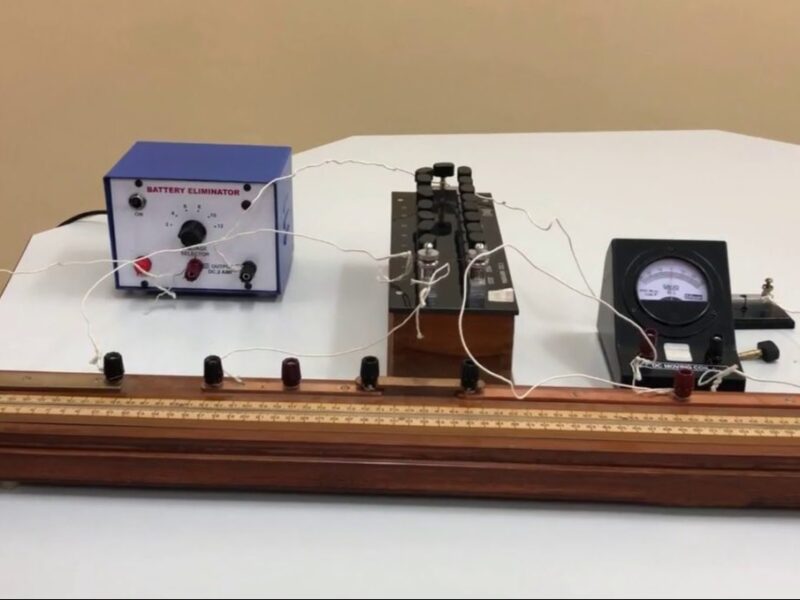
Description
Specifications Table
Product Material – High-grade metal and electronic components
Grade – Laboratory/Research Grade
Application – Frequency measurement, AC bridge circuits, impedance testing
Product Overview
The Weins Bridge (Frequency Measurement) is a sophisticated laboratory instrument designed for precise frequency analysis in electrical and electronic experiments. This bridge incorporates a built-in oscillator and null detector, eliminating the need for external components and ensuring accurate measurements. The device operates on the principle of balanced bridge circuits, where the unknown frequency is compared against a known reference frequency to achieve precise readings. Constructed with high-grade materials, it offers exceptional durability and stability during prolonged use. The integrated oscillator generates stable reference signals, while the sensitive null detector identifies the balance point with high resolution. This configuration makes it particularly suitable for applications requiring fine frequency discrimination, such as filter tuning, impedance matching, and signal analysis. The compact design ensures easy integration into existing lab setups, while its robust construction guarantees reliable performance across various experimental conditions. Whether used in educational laboratories or research facilities, this Weins Bridge delivers consistent, repeatable results for critical frequency measurement tasks.
FAQs
1. What is the working principle of this Weins Bridge?
It operates on the balanced bridge principle where the unknown frequency is compared against a known reference frequency using an AC bridge configuration with built-in oscillator and null detector components.
2. Can this bridge measure both high and low frequencies?
The measurement range depends on the oscillator’s frequency capabilities, but it is typically optimized for mid-range frequencies commonly used in laboratory experiments.
3. What power supply is required for this instrument?
Most Weins Bridges of this type require standard laboratory power supplies, typically 220-240V AC, but always verify the specific model’s requirements.
4. How does the null detector improve measurement accuracy?
The null detector identifies the exact balance point in the bridge circuit with high sensitivity, allowing for more precise frequency measurements compared to visual or manual detection methods.
5. Is this suitable for educational demonstrations?
Yes, its clear operating principle and visual balance indication make it excellent for teaching AC bridge concepts and frequency measurement techniques in educational settings.