Description
Specifications Table
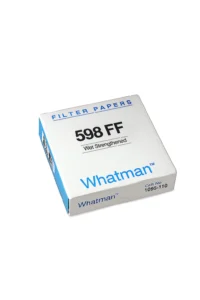
| Product Name | Whatman Grade 598 FF Cellulose Filter Paper |
|---|---|
| Pack Size | 125MM (Pack of 50) – 185MM (Pack of 50) – 240MM (Pack of 50) – 500MM (Pack of 50) |
| Form | Flat circles |
| Grade | 598 FF (Fast Flow) |
| Application | Analytical and preparative filtration, particle retention, general lab use |
Product Description
When precision matters in your lab, the right filter paper can make all the difference. Whatman Grade 598 FF cellulose filter paper is engineered for researchers, students, and educators who need reliable, fast-flowing filtration without compromising on purity. Whether you’re working on sample preparation, particle analysis, or routine lab procedures, this filter paper delivers consistent performance every time.
Grade 598 FF stands out for its balanced combination of flow rate and particle retention. The fast-flow design ensures efficient filtration, reducing wait times during experiments, while the high-purity cellulose composition guarantees minimal interference with your results. It’s a trusted choice in academic labs, research facilities, and educational institutions across India.
At eqipped, we understand the importance of quality lab supplies. That’s why we offer Whatman Grade 598 FF filter paper in multiple sizes to suit different experimental setups. From small-scale student projects to large-volume research applications, you’ll find the right pack size for your needs.
Upgrade your lab filtration with Whatman Grade 598 FF – order online today for fast delivery across India.
Why This Filter Paper Stands Out
The unique properties of Grade 598 FF make it particularly valuable in several common lab scenarios. Its medium retention rate (around 4-7 µm) makes it versatile enough for both coarse and fine particle filtration. The fast flow rate comes from its slightly thicker composition compared to standard filter papers, allowing liquids to pass through quickly while still capturing unwanted particles.
This makes it ideal for applications like: – Clarifying solutions before analysis – Preparing samples for chromatography – Routine filtration in educational labs – Environmental monitoring sample prep
Unlike some filter papers that either flow too slowly or don’t retain particles effectively, Grade 598 FF strikes the perfect balance. It’s also compatible with most common lab solvents, making it a go-to choice for diverse applications.
Practical Applications in Indian Labs
In the Indian research and education landscape, Whatman Grade 598 FF finds particular utility in several key areas:
For university students working on chemistry or biology projects, this filter paper provides reliable results without the premium price of specialized membranes. Research scholars appreciate its consistency when preparing samples for HPLC or other analytical techniques. Even in school labs, its durability makes it suitable for repeated use in basic filtration demonstrations.
The paper’s neutral pH and low ash content (less than 0.01%) ensure it won’t introduce contaminants that could skew your results. This is especially important when working with sensitive biological samples or when preparing solutions for spectroscopic analysis.
Choosing the Right Size
Selecting the appropriate diameter for your application is crucial for efficient filtration. The 125mm size works well for small-scale experiments and student projects, while the 185mm and 240mm sizes are better suited for larger volume filtrations. For industrial-scale applications or when using large Buchner funnels, the 500mm size provides ample coverage.
Remember that the filter paper should be slightly smaller than your funnel diameter for optimal performance. If you’re unsure which size to choose, consider the volume of liquid you typically filter and the size of your filtration apparatus.
Proper Usage Techniques
To get the best results from your Whatman Grade 598 FF filter paper, follow these simple guidelines:
Always handle the paper by the edges to avoid contaminating the filtration surface. For vacuum filtration, ensure the paper lies flat against the funnel base without wrinkles. When using gravity filtration, pre-wetting the paper with a small amount of solvent can help improve flow rates.
For quantitative work, it’s good practice to weigh the paper before and after filtration to determine the amount of collected material. The paper’s consistent weight and composition make it suitable for such applications.
Storage and Handling
To maintain the integrity of your filter papers, store them in their original packaging in a cool, dry place away from direct sunlight. Avoid exposing them to high humidity, which can affect their filtration properties. When removing papers from the pack, handle them carefully to prevent tearing or contamination.
Each pack of 50 sheets comes carefully packaged to protect against environmental factors during storage and transport. This ensures that when you’re ready to use them, they perform exactly as specified.
Comparing Filter Paper Grades
Whatman offers several filter paper grades, each designed for specific applications. Grade 598 FF sits between the very fast-flowing Grade 4 and the slower but finer Grade 1. While Grade 4 might be better for very coarse particles, and Grade 1 for very fine particles, Grade 598 FF offers a middle ground that works for many common lab applications.
Compared to other brands, Whatman filter papers are known for their consistent quality and reliable performance. The Grade 598 FF in particular has become a standard in many labs due to its versatility and dependability.
Sustainability Considerations
As labs become more environmentally conscious, it’s worth noting that Whatman cellulose filter papers are made from renewable resources. The production process maintains high environmental standards, and the papers themselves are biodegradable. This makes them a more sustainable choice compared to some synthetic filter materials.
At eqipped, we’re committed to offering products that not only meet your technical requirements but also align with responsible lab practices. The Grade 598 FF filter paper exemplifies this balance between performance and environmental consideration.
Common Questions About Filter Paper Selection
Many lab professionals wonder about the difference between qualitative and quantitative filter papers. While both can be used for general filtration, quantitative papers like Grade 598 FF are manufactured to higher purity standards and have more consistent ash content, making them suitable for analytical work where the weight of the collected material matters.
Another frequent question concerns the difference between cellulose and glass fiber filter papers. Cellulose papers like this one are generally better for aqueous solutions and organic solvents, while glass fiber papers excel with aggressive chemicals and high-temperature applications.
FAQs
What is the particle retention size for Whatman Grade 598 FF filter paper?
Grade 598 FF typically retains particles larger than 4-7 micrometers, making it suitable for medium-fine filtration applications in laboratories.
Can this filter paper be used for both organic and aqueous solutions?
Yes, Whatman Grade 598 FF is compatible with most common organic solvents and aqueous solutions, making it versatile for various lab applications.
How should I dispose of used filter papers?
Used filter papers should be disposed of according to your lab’s chemical waste protocols. If they’ve been used with hazardous materials, they should go in appropriate waste containers. For non-hazardous use, they can typically be discarded with regular lab waste.
Is this filter paper suitable for vacuum filtration?
Absolutely. Grade 598 FF works well with both gravity and vacuum filtration setups. Its strength prevents tearing under typical vacuum pressures used in labs.
What’s the difference between Grade 598 and other Whatman filter paper grades?
Grade 598 FF offers a balance between flow rate and particle retention. It’s faster than Grade 1 but retains finer particles than Grade 4, making it ideal for general lab filtration needs where both speed and efficiency matter.