Description
Specifications Table
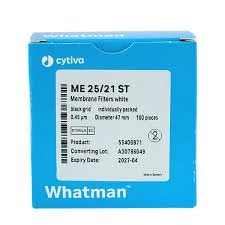
Product Name – Whatman ME25/21 STL Membrane Filter
Quantity/Pack Size – 47MM,0.45uM (Pack of 400), 50MM,0.45uM (Pack of 400)
Form – Membrane Disc
Grade – Mixed Cellulose Esters (MCE)
Application – Sterile Filtration, Clarification, Particle Removal
Product Overview
The Whatman ME25/21 STL membrane filter is engineered for high-performance sterile filtration in laboratory environments. Constructed from mixed cellulose esters (MCE), this filter combines a 0.45?m pore size with a smooth, uniform surface to ensure consistent particle retention and high flow rates. The hydrophilic nature of the membrane allows for rapid wetting and efficient filtration of aqueous solutions, making it ideal for applications requiring sterility and clarity. Its low extractables profile minimizes sample contamination, while the sturdy construction resists tearing during handling. The white grid marking on the filter surface aids in sample visualization and even distribution. Available in 47MM and 50MM diameters, each pack contains 400 filters, providing cost-effective bulk options for high-throughput workflows. The ME25/21 STL variant is specifically designed to meet stringent quality standards, with each batch undergoing rigorous testing for integrity and performance. Its compatibility with standard filtration apparatus and autoclaving procedures further enhances its versatility in lab settings. The filter’s consistent performance across a wide pH range (1-14) ensures reliability in diverse experimental conditions.
FAQs
1. What is the chemical compatibility of Whatman ME25/21 STL membrane filters?
These filters are compatible with most aqueous solutions, alcohols, and mild organic solvents. Avoid strong acids, bases, or halogenated hydrocarbons that may degrade the cellulose ester matrix.
2. Can these filters be autoclaved before use?
Yes, Whatman ME25/21 STL filters can be autoclaved at 121?C for 15-20 minutes. Ensure they are dry before autoclaving to prevent pore distortion from steam condensation.
3. How does the grid pattern on these filters help during filtration?
The printed grid allows for easy visualization of sample distribution across the filter surface, helps identify clogging areas, and assists in quantitative analysis by providing reference points.
4. What’s the difference between ME25 and ME25/21 variants?
The ME25/21 variant features a smoother surface finish and tighter thickness tolerance compared to standard ME25 filters, resulting in more consistent flow rates and improved particle retention.
5. Are these filters suitable for protein binding studies?
While primarily designed for general filtration, these MCE filters exhibit moderate protein binding. For low-binding applications, consider pre-wetting with a blocking solution or using specialized low-protein-binding membranes.