Description
Specifications Table
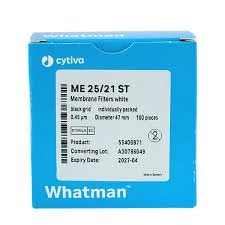
Product Name – Whatman ME25/41 STL Membrane Filter
Quantity/Pack Size – 47MM,0.45uM (Pack of 400), 50MM,0.45uM (Pack of 400)
Form – Membrane Disc
Grade – Mixed Cellulose Esters (MCE)
Application – Sterile Filtration, Clarification, Particle Analysis
Product Overview
The Whatman ME25/41 STL membrane filter is engineered for high-performance filtration in laboratory settings, offering consistent results for critical applications. Constructed from mixed cellulose esters (MCE), this filter combines mechanical strength with chemical compatibility, ensuring reliable particle retention and flow rates. The 0.45?m pore size is optimized for general sterile filtration, bacterial retention, and clarification tasks, making it a versatile choice for routine lab procedures. Its smooth, uniform surface minimizes particle binding, while the hydrophilic nature ensures rapid wetting and even fluid distribution. The STL variant is pre-sterilized via gamma irradiation, eliminating the need for autoclaving and reducing contamination risks. Compatible with most aqueous and mild organic solutions, this filter maintains integrity across a wide pH range (3?10), though prolonged exposure to strong acids or bases should be avoided. The white, grid-marked surface allows for easy particle visualization under microscopy, enhancing analytical workflows. Whether used in syringe filters, vacuum manifolds, or pressure-driven systems, the Whatman ME25/41 STL delivers reproducible performance with low extractables, ensuring minimal interference in downstream applications. Its thermal stability up to 120?C further expands its utility in heat-sensitive processes.
FAQs
1. What is the maximum operating temperature for Whatman ME25/41 STL filters?
The filters can withstand continuous operation at temperatures up to 120?C, though brief exposure to higher temperatures may be possible depending on the solvent system. Avoid dry heat sterilization, as it may compromise membrane integrity.
2. Can these filters be used with organic solvents like acetone or methanol?
While compatible with mild organic solvents, prolonged exposure to aggressive solvents like acetone may degrade the mixed cellulose ester matrix. For such applications, consider PTFE or nylon membranes as alternatives.
3. How should unused filters be stored to maintain sterility?
Store the filters in their original sealed packaging at room temperature (15?30?C), away from direct sunlight and moisture. Avoid opening the pack until ready for use to prevent microbial contamination.
4. Is this filter suitable for protein binding studies?
The MCE membrane exhibits moderate protein binding, which may interfere with quantitative assays. For low-binding requirements, opt for cellulose acetate or PES membranes instead.
5. What alternatives exist for filters with higher chemical resistance?
For applications involving strong acids, bases, or harsh solvents, PTFE (polytetrafluoroethylene) or PVDF (polyvinylidene fluoride) membranes offer superior chemical resistance while maintaining similar pore size options.