Description
Specifications Table
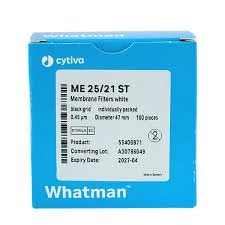
Product Name – Whatman ME25/51 ST Membrane Filter
Quantity/Pack Size – 100 filters (47mm diameter, 0.45µm)
Form – Circular membrane discs
Grade – Mixed Cellulose Ester (MCE)
Application – Sterile filtration, particle retention, microbiological analysis
Product Overview
The Whatman ME25/51 ST Membrane Filter is a high-performance mixed cellulose ester (MCE) membrane designed for critical laboratory filtration applications. With a precise 0.45µm pore size and 47mm diameter, these sterile filters deliver exceptional particle retention while maintaining high flow rates for efficient processing. The hydrophilic nature of the membrane ensures compatibility with aqueous solutions, making it a versatile choice for general filtration needs. Engineered with low protein binding properties, these filters minimize sample loss during biological and chemical filtrations. The uniform pore structure provides consistent performance across all filters in the pack, ensuring reliable results in repetitive experiments. Each filter undergoes strict quality control to meet international standards for purity and performance. The white, grid-marked surface allows for easy particle visualization under microscopy, while the robust construction prevents tearing during handling. These filters are gamma-irradiated for sterility and individually packaged to maintain integrity until use.
FAQs
1. What is the chemical compatibility of Whatman ME25/51 ST filters?
These MCE membranes are compatible with most aqueous solutions, mild acids, and alcohols. Avoid using with strong acids, bases, or organic solvents that may degrade cellulose esters.
2. How should these filters be stored for optimal shelf life?
Store in original packaging at room temperature (15-30°C) in a dry environment. Avoid exposure to direct sunlight or humidity to prevent premature degradation.
3. Can these filters be autoclaved before use?
While gamma-irradiated for sterility, these filters can be autoclaved at 121°C for 15 minutes if additional sterilization is required, though this may slightly affect flow rates.
4. What alternatives exist for higher protein retention applications?
For applications requiring lower protein binding, consider PES (polyethersulfone) or nylon membranes, though these may have different chemical compatibility profiles.
5. How does the grid marking affect filtration performance?
The grid marking is purely for visual reference during microscopy and doesn’t impact filtration efficiency or flow characteristics of the membrane.