Description
Specifications Table
| Product Name | Whatman NC45 Membrane Filter | 10401106 |
|---|---|
| Pack Size | 25MM, 0.45uM (Pack of 100) | 47MM, 0.45uM (Pack of 100) | 50MM, 0.45uM (Pack of 100) | 85MM, 0.45uM (Pack of 50) | 90MM, 0.45uM (Pack of 50) | 100MM, 0.45uM (Pack of 50) | 110MM, 0.45uM (Pack of 50) | 142MM, 0.45uM (Pack of 25) |
| Form | Membrane Filter |
| Grade | NC45 (Nitrocellulose) |
| Application | Microbiological analysis, sterile filtration, environmental monitoring |
Product Description
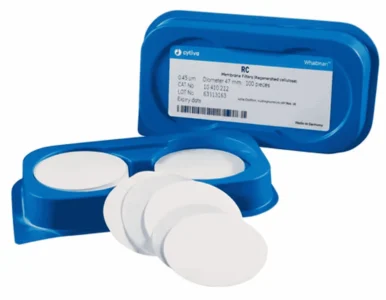
When precision matters in your lab, the Whatman NC45 Membrane Filter delivers unmatched performance. Designed for researchers, students, and educators, this nitrocellulose filter ensures accurate particle retention with its 0.45µm pore size, making it a staple in microbiology labs, environmental testing, and sterile filtration processes.
Whether you’re filtering bacteria, clarifying liquids, or preparing samples for analysis, the NC45 membrane provides consistent results. Its high protein-binding capacity and low extractables make it ideal for sensitive applications where purity is critical. Available in multiple diameters, you can choose the perfect size for your setup—from 25mm for small-scale work to 142mm for larger volumes.
At eqipped, we understand the importance of reliable lab supplies. That’s why we stock genuine Whatman filters, trusted by professionals worldwide. Each pack is carefully sealed to maintain sterility, ensuring your experiments start with the right foundation.
Upgrade your lab filtration today—buy Whatman NC45 Membrane Filters online and experience the difference quality makes.
Why This Filter Stands Out
The NC45 membrane isn’t just another filter—it’s engineered for performance. Its uniform pore structure guarantees consistent flow rates, reducing clogging and saving you time. Unlike generic alternatives, Whatman’s nitrocellulose formulation resists chemical degradation, so you get dependable results even with aggressive solvents.
For educators, this filter simplifies classroom demonstrations. Students can observe microbial colonies clearly, thanks to the membrane’s smooth surface and high contrast. Researchers appreciate its compatibility with automated filtration systems, streamlining workflows in busy labs.
Applications You Can Trust
From water quality testing to pharmaceutical research, the NC45 filter adapts to diverse needs:
- Microbiological analysis of water, food, and beverages
- Sterile filtration of culture media and buffers
- Environmental monitoring for airborne particles
- Protein binding studies and immunoblotting
Its versatility extends to academic projects too. Whether you’re a student isolating bacteria for a thesis or a professor setting up a lab practical, this filter ensures reproducibility—every time.
Choosing the Right Size
Selecting the correct diameter is key to efficient filtration. Smaller discs (25mm–50mm) fit standard syringe filters and vacuum manifolds, while larger sizes (85mm–142mm) handle higher sample volumes. eqipped offers all pack sizes, so you can stock up without compromise.
Need bulk quantities for your institution? Contact eqipped for tailored solutions—we’re here to support your research goals.
Safety and Handling
While nitrocellulose membranes are generally safe, always follow standard lab protocols:
- Wear gloves to avoid contamination
- Store in a cool, dry place away from flames (nitrocellulose is flammable)
- Dispose of used filters according to biohazard guidelines
FAQs
What is the pore size of Whatman NC45 filters?
The NC45 membrane has a 0.45µm pore size, ideal for retaining bacteria and fine particles while allowing liquids to pass through efficiently.
Can I autoclave these filters?
No, nitrocellulose membranes are not autoclavable. For sterile applications, use them with pre-sterilized equipment or gamma-irradiated filters.
Are these filters compatible with organic solvents?
Yes, but prolonged exposure to strong solvents like acetone may degrade the membrane. For solvent-resistant needs, consider PTFE filters.
How do I store unused filters?
Keep them in their original packaging at room temperature. Avoid humidity and direct sunlight to maintain integrity.
Can I use NC45 filters for protein binding assays?
Absolutely. Their high protein-binding capacity makes them suitable for Western blotting and other protein-based applications.