Description
Specifications Table
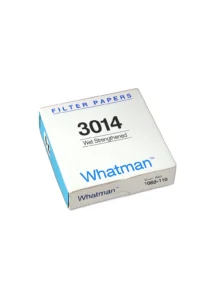
| Product Name | Whatman Grade 3014 Cellulose Filter Paper |
|---|---|
| Pack Size | 110x20MM (Pack of 100), 110x20MM (Pack of 1000) |
| Form | Sheets |
| Grade | 3014 |
| Application | General laboratory filtration, qualitative analysis |
Product Description
When precision matters in your lab work, the right filtration tool can make all the difference. Whatman Grade 3014 cellulose filter paper is a trusted choice for researchers, students, and educators who need reliable, medium-speed filtration for routine laboratory tasks. Whether you’re filtering solutions, clarifying liquids, or performing qualitative analysis, this filter paper delivers consistent results every time.
Made from high-purity cellulose, Whatman Grade 3014 offers a balance between flow rate and particle retention, making it versatile for a wide range of applications. Its smooth surface ensures even particle distribution, while its chemical compatibility allows it to work seamlessly with most common lab solvents and aqueous solutions. Unlike cheaper alternatives, this filter paper maintains structural integrity even under moderate pressure, reducing the risk of tears or clogs during critical experiments.
One of the standout features of Whatman Grade 3014 is its uniformity. Each sheet is manufactured to strict quality standards, ensuring that every batch performs identically. This consistency is especially valuable in educational settings where students need predictable results to learn proper filtration techniques. For researchers, it means fewer variables to account for in experimental protocols.
Available in convenient pack sizes of 100 or 1000 sheets, this filter paper is designed to meet the needs of both small-scale users and high-volume laboratories. The 110x20mm dimensions fit standard filtration setups, making it easy to integrate into existing workflows without requiring special equipment. Whether you’re setting up a new lab or restocking supplies, eqipped offers competitive pricing and reliable delivery to keep your research on track.
Upgrade your lab filtration today with Whatman Grade 3014 cellulose filter paper—order now for fast shipping across India.
Beyond its technical specifications, Whatman Grade 3014 is also an economical choice for budget-conscious labs. Its durability means fewer replacements over time, and its efficiency reduces solvent waste by minimizing the need for re-filtration. For institutions managing tight budgets, this filter paper provides professional-grade performance without the premium price tag of specialized membranes.
In educational environments, this filter paper serves as an excellent teaching tool. Its predictable performance helps students understand fundamental filtration principles, while its real-world applicability prepares them for professional lab settings. Many Indian universities and research institutions rely on Whatman products for their consistent quality, and Grade 3014 is no exception.
For those working in environmental testing, food analysis, or pharmaceutical quality control, this filter paper meets the basic requirements for many standard protocols. While it may not replace ultra-fine membranes for sub-micron filtration, it excels in preliminary filtering steps where speed and cost-efficiency are priorities.
Common Applications
Whatman Grade 3014 cellulose filter paper finds use in numerous laboratory applications, including:
Qualitative analytical procedures where moderate retention is sufficient
Clarification of solutions before further analysis
Student laboratory exercises in chemistry and biology courses
Routine filtration in research and quality control labs
Pre-filtration to extend the life of more expensive membrane filters
When selecting filter paper for your specific needs, consider the particle size you need to retain and the flow rate required for your application. Whatman Grade 3014 strikes an excellent balance for many common tasks, but for more specialized requirements, you might explore other grades in the Whatman lineup available through eqipped.
Storage and Handling
To maintain optimal performance, store your Whatman Grade 3014 filter paper in a cool, dry environment away from direct sunlight and chemical fumes. Keep the original packaging sealed when not in use to prevent contamination from dust or moisture. When handling, use clean forceps or gloves to avoid transferring oils or particulates from your hands to the filter surface.
For laboratories processing multiple samples, consider dedicating specific areas for filter paper storage to minimize cross-contamination risks. Always follow your institution’s standard operating procedures for filter paper handling to ensure reproducible results in your experiments.
Why Laboratories Trust Whatman
With over a century of experience in filtration technology, Whatman has become synonymous with quality in laboratories worldwide. Their cellulose filter papers are manufactured using carefully controlled processes that ensure batch-to-batch consistency. This reliability is particularly important in research settings where experimental reproducibility is crucial.
The Grade 3014 specification represents a sweet spot in the Whatman product range—offering better performance than basic filter papers without the premium cost of specialized grades. This makes it an intelligent choice for labs that need dependable filtration without overspending on features they don’t require.
In India’s growing scientific community, where both established research institutions and new educational programs are expanding, Whatman products have gained particular popularity. Their availability through trusted suppliers like eqipped ensures that labs across the country can access genuine filter papers without concerns about counterfeit or substandard alternatives.
FAQs
What is the particle retention size for Whatman Grade 3014 filter paper?
Whatman Grade 3014 typically retains particles larger than 6-8 microns, making it suitable for general filtration tasks where fine particle removal isn’t critical.
Can this filter paper be used with organic solvents?
Yes, Whatman Grade 3014 cellulose filter paper is compatible with most common organic solvents used in laboratories, though prolonged exposure to strong acids or oxidizing agents may affect performance.
How does Grade 3014 compare to other Whatman filter papers?
Grade 3014 offers medium flow rate and retention, positioning it between faster grades like 1 and slower grades like 4. It’s ideal when you need a balance between speed and filtration efficiency.
Is this filter paper suitable for quantitative analysis?
While primarily designed for qualitative work, Grade 3014 can be used for some quantitative applications where high precision isn’t required. For critical quantitative work, consider Whatman’s ashless grades.
What’s the best way to cut Whatman filter paper to size?
Use clean scissors or a paper cutter, and handle the paper by the edges to avoid contamination. For circular filters, a sharp punch works well—just ensure it’s cleaned between uses.