Description
Specifications Table
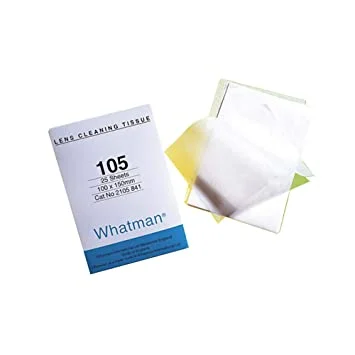
Product Name – Whatman Grade 105 Lens Cleaning Tissue
Quantity/Pack Size – 10x15CM (Pack of 25), 20x30CM (Pack of 100), 46x57CM (Pack of 500)
Form – Tissue Sheets
Grade – Grade 105 (Optical Grade)
Application – Cleaning lenses, mirrors, prisms, and delicate optical surfaces
Product Overview
Whatman Grade 105 Lens Cleaning Tissue is engineered for precision cleaning of delicate optical surfaces, offering unmatched softness and lint-free performance. Made from high-purity cellulose fibers, this tissue ensures minimal abrasion, making it ideal for lenses, mirrors, and prisms where scratch resistance is critical. The tissue undergoes rigorous quality control to maintain low extractables and chemical inertness, preventing residue or contamination during use. Its uniform texture and absorbent properties allow for efficient removal of dust, oils, and fingerprints without leaving streaks or fibers behind. Unlike conventional wipes, Grade 105 is designed to disintegrate minimally when wet, ensuring consistent performance even with solvent-based cleaners. The tissue?s neutral pH and absence of binders or additives further enhance its compatibility with coated optics and sensitive instruments. Available in multiple sheet sizes, it caters to both small-scale lab cleaning and bulk applications, providing versatility without compromising quality. Whether used dry or with isopropyl alcohol, this tissue delivers reliable results, reducing the risk of damage to high-value optical components. Trusted by professionals, it combines durability with gentleness, making it a staple in laboratories, workshops, and research facilities where precision matters.
FAQs
1. Can Whatman Grade 105 tissue be used with cleaning solvents?
Yes, it is compatible with common solvents like isopropyl alcohol, acetone, and ethanol, though it may soften slightly when wet. Always test on a small area first.
2. What makes Grade 105 different from regular lens tissues?
Grade 105 is manufactured with ultra-pure cellulose, free from binders or additives, ensuring no residue or scratches on sensitive surfaces. Regular tissues often contain fillers that can abrade optics.
3. How should I store unused sheets to maintain their quality?
Store in a cool, dry place within the original packaging or an airtight container to prevent moisture absorption and contamination from dust or lab fumes.
4. Is this tissue suitable for cleaning camera lenses?
Yes, its lint-free and non-abrasive properties make it safe for camera lenses, but avoid excessive pressure to prevent micro-scratches on coated surfaces.
5. Are there alternatives for heavy-duty optical cleaning?
For stubborn contaminants, consider microfiber cloths or solvent-wetted swabs, but Grade 105 remains the safest choice for routine maintenance of delicate optics.