
Description
Specifications Table
Product Name – Whatman Grade 40 Pyramid Fold Filter Paper
Quantity/Pack Size – 125MM (Pack of 100), 12.5CM (Pack of 1000)
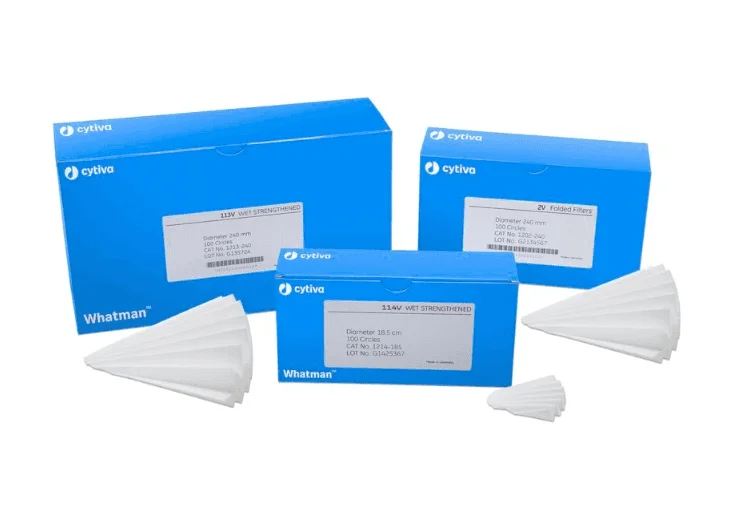
Form – Pyramid-folded sheets
Grade – 40 (Medium retention, 8?m)
Application – General lab filtration, qualitative analysis, particle retention
Product Overview
Whatman Grade 40 Pyramid Fold Filter Paper is engineered for reliable performance in laboratory filtration tasks requiring medium particle retention. With an 8-micron retention rating, this filter paper balances flow rate and filtration efficiency, making it a versatile choice for routine qualitative analysis. The pyramid-fold design maximizes surface area, enhancing filtration speed while maintaining consistent particle capture. Made from high-purity cellulose, it ensures minimal extractables and chemical interference, preserving sample integrity. The acid-washed treatment further reduces ash content, making it suitable for applications where purity is critical. This grade is particularly effective for filtering aqueous solutions, organic solvents, and fine precipitates. The pre-creased folds eliminate the need for manual folding, saving time and reducing contamination risks. Whether used in gravity or vacuum filtration setups, Whatman Grade 40 delivers reproducible results with minimal clogging. Its uniform thickness and porosity provide even flow distribution, preventing premature blockage. The filter paper is compatible with standard lab funnels and filtration apparatus, ensuring seamless integration into existing workflows. The pack sizes cater to both small-scale experiments and high-throughput applications, offering flexibility for different lab requirements.
FAQs
1. What is the particle retention capacity of Whatman Grade 40 filter paper?
This filter paper retains particles down to 8 microns, making it suitable for medium-fine filtration tasks in laboratory settings.
2. Can this filter paper be used with organic solvents?
Yes, Whatman Grade 40 is compatible with most organic solvents commonly used in lab filtration processes.
3. How does the pyramid fold design improve filtration?
The pyramid-fold pattern increases the effective surface area, allowing for faster flow rates while maintaining consistent particle retention.
4. What is the ash content of this filter paper?
The acid-washed treatment reduces the ash content to less than 0.06%, ensuring minimal interference in analytical procedures.
5. Is this filter paper suitable for quantitative analysis?
While primarily designed for qualitative work, it can be used for semi-quantitative applications where medium precision is acceptable.